Showing posts with label mckinney. Show all posts

Wednesday, October 26, 2011

Criminal Defense Lawyer


Criminal Offense

If you are facing serious time in jail, an attorney specialized in criminal law is your best bet. Criminal lawyers are specialized in family violence, drinking and driving (DUI/DWI) cases, sexual conduct, drug offenses and felonies. Even the best and brightest don't stand a chance deffending themselves in court. Your experienced defense attorney is well versed in defense arguments and are your best bet for factors that might mitigate your crimes.

Criminal Defense

During a criminal trial defense attorneys know what is going on better than you. They have an objective standpoint and know what to expect. During trial they can point out legalities and pin point errors in charges that you would never catch on your own. Defense attorneys also have experience dealing with wittnesses who might be hesitant to appear in court or are scared for their safety. Witnesses might be much more willing to talk to the defense attorney about procedural information.

Specialized Mitigation

Defense attorneys also know the outlets and mitigations to plea bargains. If sentenced to a lesser charge a standard period of jail time could be lessened to a rehabilitation facility and miniamal jail time. Your attorney's task it to spot the specific characteristics in your case and use them to your defensive advantage, many or all wouldn't be seen by an untrained eye. Please consult your trusted McKinney Attorney to discuss options for your criminal defense case.

Tuesday, October 11, 2011

Horizontal Gaze Nystagmus DUI


The DUI Eye Test

The Horizontal Gaze Nystagmus (HGN) is to test the ability to follow an object smoothly at different angles. Nystagmus can only be spotted by a doctor but alcohol and other stimulants increase jerking movements of the eye. Not only people under the influence of alcohol can exhibit symptoms of HGN; head trauma, neurological disorders and certain medications can show symptoms. There are many reasons for failure on this test, please speak with your local attorney to go over other reasons or mistakes in police interpretation.

The Eye Test

When the test is administered the officer is looking for jerking movement while moving the stimulus horizontally across the vision scope. Stimulus includes a finger, pen or light. The officer will ask you to stand with your feet together arms at your side. You’re going to be asked a series of “Do you understand?” after each instruction. Then the officer will do a demonstration of moving the stimulus, usually finger horizontally watching for distinct clues of impairment. Some clues are jerking of the eye at each corner of vision. Finally, the officer administers the test and watches for fluidity in eye movements. Officers have to be specially trained in many states in order for this test to hold credibility in court. It is up to the officer to administer this test correctly for HGN to be pertinent to the case.

If you are accused for DUI and have been administered this test, please consult a local area DUI defense attorney for further information. DWI and DUI traffic stop advice here.


Tuesday, June 7, 2011

Consenting to a Vehicle Search

DUI vehicle search
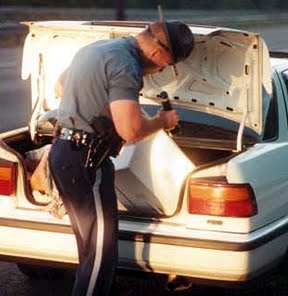
A question that is often asked is regarding giving a police officer consent to search your vehicle. The short answer to this question is, NO! If a police officer is asking you for consent to search your vehicle you can politely decline.

When an officer wants to conduct a vehicle search there are three ways he can go about this, 1. consent from the owner of the car. 2. probable cause 3. reasonable suspicion. The Fourth Amendment of the Bill of Rights protects against unreasonable search and seizure.

Probable cause exists when the officer believes that evidence of a crime could be located in the area to be searched. This can be due to circumstances and under the conditions that a reasonable person would believe that a search would yield evidence of a crime. With probable cause, law enforcement officers may search any area of the vehicle where the probable cause leads them to believe evidence could be found.

If you are asked for consent to search your vehicle and you feel that you have not done anything that would warrant a search, politely decline the search and state that you wish to invoke your constitutional rights to privacy.

However, if anything in "plain sight" looks incriminating, the officer will have probable cause to search your vehicle and can also seize any evidence that is obtained.

If you believe you have been pulled over for DUI in Frisco, you have the right to invoke your fifth amendment rights to remain silent before you speak to an Frisco DUI Lawyer.

Thursday, June 2, 2011

You've Been Pulled Over for DUI, What Now?


The number one reason drivers are pulled over for suspicion of DUI is erratic driving. Many drivers who have been drinking do not realize how they are driving and are less aware of their surroundings. Once an officer has pulled you over, he will start to collect evidence to build a case against you and charge you with driving under the influence.

The biggest reason that DUI cases are tough to prosecute is that evidence is largest part of the case. If a procedure is not followed or any evidence is collected improperly it becomes inadmissible in court.

Many people are unaware that you are not require to answer any questions from a police officer or make any statements that could be used against you. Under the fifth amendment, you choose to not speak to the police until you have an attorney present.

A DUI Attorney has specialized knowledge and training to determine how evidence was collected and if all procedures were followed correctly. If just one part of a procedure is missed, that can have a big effect on the outcome of the case and even determine whether the district attorney can prosecute you and if the charges will stick.

Tuesday, May 24, 2011

All about the Breathalyzer Test

You have probably heard of a breathalyzer before but how do they work? Actually, there are several different kinds of breathalyzers. The term breathalyzer is just the generic term for a breath testing device.

A breathalyzer is used to determine a person's level of intoxication but they are not fool proof. A breath test is simply a piece of evidence that can be used against you in a case to prove your guilt. There are two main types of breath tests that a police officer may administer.

The first breath test may be administered from a small hand held device that the officer will use in the field. This is known as a PBT or preliminary breath test. This is to determine if you are intoxicated and will give the officer the ability to arrest a suspect.

The breathalyzer typically found at the police station will use a technology known as infrared spectroscopy or gas chromatography. Many current day machines use a combination of infrared and fuel cell technology.

Kyle K. Shaw is a Frisco DWI Attorney and is regarded as one of the best criminal attorneys in Collin County.

Monday, May 9, 2011

What Happens With a Second DUI Offense?

In Texas, the penalty for DUI for a first offense carries a penalty of a Class B Misdemeanor with mandatory jail time, a fine not to exceed $2000 and a license suspension. Typically, you will also be required to undergo a year of probation.

However, if you are arrested for a second offense, the penalty carries with it a Class A Misdemeanor with a Special Condition for Jail Release on Bond. This means that you will serving an extended period of time in jail with a fine not to exceed $4000 and you could lose your license for two years.

If the first DUI didn't sober you up to the fact that drinking and driving is not a good decision, the second offense should do the trick.

Remember if you have been arrested under suspicion of DUI in Collin County, TX, give yourself the best representation with Kyle Shaw.